Wednesday, 20 March 2019

28mm Tercio de Burgos, "Amarillos Viejos" (Old Yellows)

Hello there!

This month I have finished (finally) the last of the five provincial tercios based in the Iberian peninsula, for my late XVII c. Spanish army.  Tercio de Burgos, known as the Old Yellows or "Amarillos Viejos".

We know the flags and the yellow uniform, BUT some sources say the cuffs and leggins were blue and others say they were red...  I preferred painting them in red, but the blue option seems to have more historical weight.

Anyway, this Tercio was formed on 22 January 1657, and  Don Geronimo de Benavente y Quiñones was appointed as Maestre de Campo of what would become the Amarillos Viejos. It first actions were in the war against Portugal until 1668 when it gained its independence. 

In 1664 it became Tercio Provincial de Burgos, a veteran unit which fought against the French in the Franco Dutch War 1672-78 and in the League of Augsburg War 1689-97,  fighting in every major battle in those conflicts in the Catalan front of the war, like battle of river Ter in 1694 and Barcelona in 1697 just to name a couple.

The miniatures are mostly Northstar 1672/ Phoenix Miniatures  Spaniards, with some additions like the officer and a couple of pikemen which were  sculpted for me by a freelance.  There is also a Northstar 1672 Swiss musketeer, converted into Spanish with a plume and front lappels added, just to add some variety.

The flag is by Adolfo Ramos Flags,  and the painting was with Vallejo and Foundry paints. As yellow is a tricky colour to paint over black (and over every colour!) I airbrushed a desert yellow or ochre colour to the whole unit to serve as a second primer or base colour, then washed over and painted in the Foundry style "triads" but with 4 and 5 highlights in most cases, trying to blend the different colours in thin layers, using the excellent GW "Lahmian medium" instead of water.

Enough talking, here are the minis:


some close ups:


the pikeman on the left was sculpted just for this project.

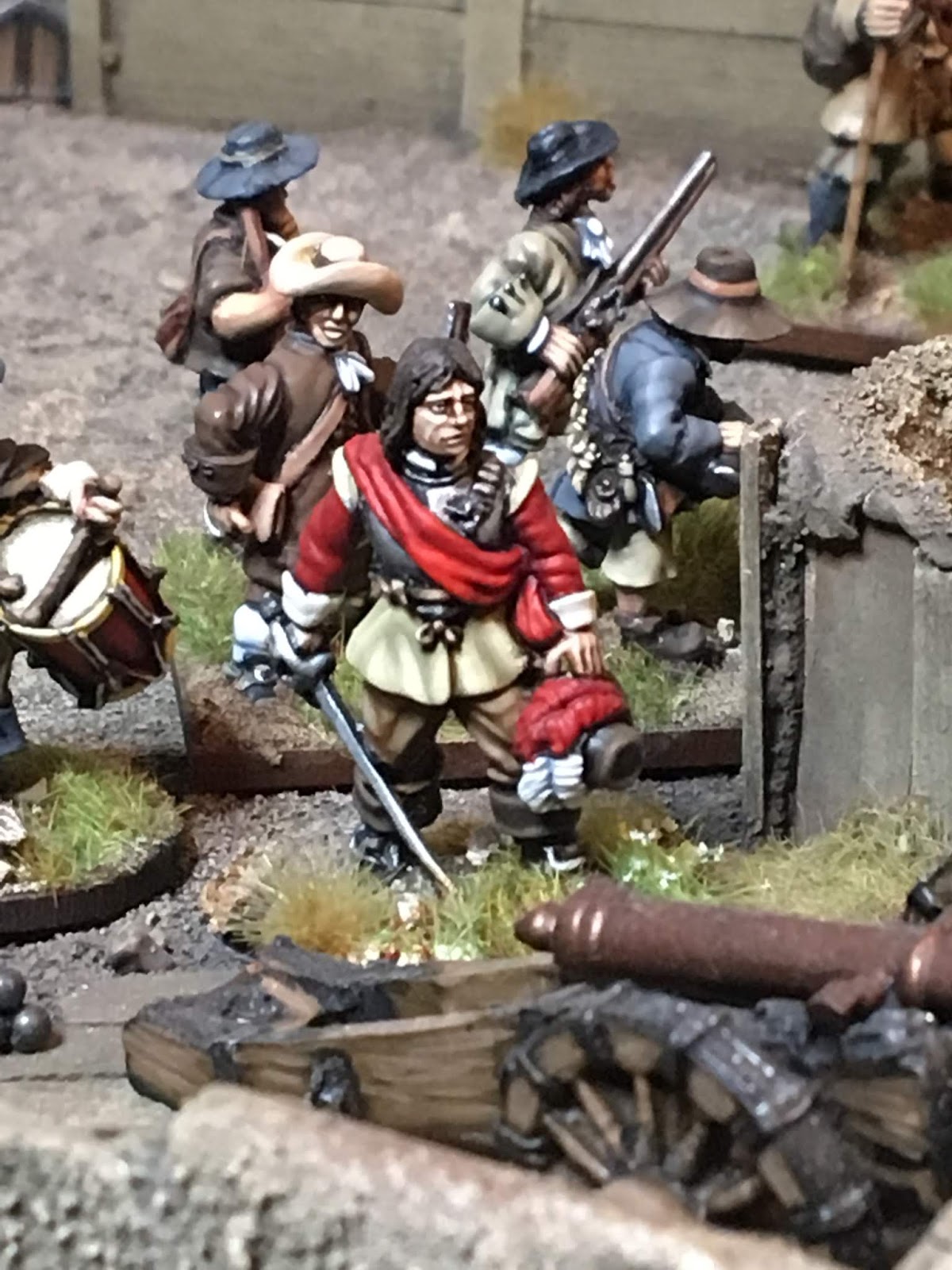
the officer was sculpted for this project.


Swiss on the back and left, was converted with greenstuff feather and front lappels in red.


I hope you like it !


by the way, there is even a beer called "Amarillos Viejos" !


Thursday, 7 March 2019

The defense of Dendermonde, 1667


The battle I have chosen, is the siege of Dendermonde, and the cavalry skirmishes that followed the siege... Why? This is the first of the wars for "Gloire" of the Sun King, and, until this action, the French marched almost unmolested through the Habsburg controlled Netherlands,  and it was one of the few French defeats in this conflict.

The War of Devolution (1667–68) saw the French armies of Louis XIV overrun the Habsburg-controlled Spanish Netherlands and the Franche-Comté, only to be pressured to give most of it back by a Triple Alliance of England, Sweden and the Dutch Republic, besides, the Spanish had made peace with Portugal and were preparing a big army to be sent to Flanders. France was not prepared to fight all those nations alone, so the war ended in the Treaty of Aix-la-Chapelle. 

The summer campaign of 1667 began extremely well for the French troops, they took almost without effort a chain of villages and towns in Spanish Flanders.

Marquis of Castel-Rodrigo was the Viceroy of Spanish Netherlands, he desperately asked for native peninsular Spanish troops, just before the war, but he received no reinforcements... the Spanish troops were deployed in the Portuguese frontier, so Castel-Rodrigo only could count initially with 20.000 men, garrisoning the most important places and cities. Walloon, Germans and a few native Spanish and Italians. French forces fielded over 70.000 men in the whole campaign.

After various easy conquests, the French army arrived  Dendermonde... or Terramunda in Spanish.
For the conquest of Terramunda, the French grouped most of their troops, the armies of Marshall Aumont and the army of Turenne, accompanied by Louis XIV himself. Therefore, most of the invasion troops were engaged, with the King himself, in the siege of the city.


The forces that defended Dendermonde were as follows:

-2 free companies; one of Spanish (led by captain Francisco Ramirez) and another of Walloons, both numbered almost 100 men.

-From Brussels, Count of Marsin, sent almost 1000 men: 300 men of Spanish Tercio of Monterrey, 300 men of German regiment Monfort, 200 men of Walloon Tercio of Tursi, and 200 mounted troops that managed to enter the town at night, without alerting the French besiegers.

-From Ghent, the prince of Ligné, Governor of all Flanders cavalry, sent between 300 and 500 mounted troops, to skirmish in the area and open the locks and dykes.

all the previous troops were put under the command of Baron de Berlo, commander of the garrison, who ordered the town militia to join his small force. Count Louvigny commanded the cavalry reinforcements which had just arrived.

 one of the redoubts and ravelins of the city, apart from the medieval walls


Militia and regular troops prepare the defenses of Dendermonde


 The first French actions focused on completing a defensive ring to surround the town, and isolate it from any relief of Hispanic troops, ammunition or food. For this, it was necessary for the French to build a bridge over the Escalda river, that would allow communication between the two French campaign armies and encampments.

Once the bridge was built, French cavalry, numbering 300 troops, went through this route to secure the positions, in that moment, the Spanish made a sortie, Maestre de Campo Louvigny attacked them with 150 of his men. The action was a success, and despite their numerical inferiority, the Hispanic troops charged and defeated the French cavalry deployed on the bridge, killing and wounding many of them, with only the loss of a captain in the Spanish side. With this action it was clear that the town was going to be defended, and also it gave the Spanish some time to reorganize and control the defenses, while the surrounding fields were totally flooded. 

 French cavalry near the walls, have just crossed the newly built bridge

Spanish cavalry, in inferior numbers, manage to rout the French


The defenses of Terramunda were not too modern or advanced. The protection offered by the medieval walls and round towers was complemented by the natural cover of both Dender and Escalda rivers, along with the canals that surrounded the town, so the pits that surrounded the city were real channels that made any assault difficult. Apart from these old defenses,  several ravelins were added in the weakest areas and entry gates, which reinforced the defenses and safeguarded the passage by the various bridges that communicated the town with the outside. 

In order to summarize, the greatest defensive advantage that the town possessed was the power of the waters. If the surrounding locks were opened, the surroundings of the town would be flooded,  making the city a true island. Above the flooded terrain, only the roads leading to the city, artificially constructed and higher than the labour lands of the contours, remained dry.

These peculiarities offered by Terramunda are going to be used by the defenders to brilliantly repel enemy assaults. The French decided to storm the city the day after of the galant cavalry charge of Maestre de Campo Louvigny, on August 4th.

The French managed to surround the entire town with trenches, with the aim of achieving total isolation of the city. The use of the siege artillery should not be an easy task, in the face of the flood ed fields... due to the impossibility of gradually approaching the walls with the artillery. Therefore, the siege pieces could not play a key role, although the French managed to make use of them by placing them in higher areas. Apparently, only one of the roads that led to the town was maintained above the water level, probably the road to Mechelen, so the French mass assault was made at that point. 

French fortified positions

The 300 Spaniards of the Tercio del Conde de Monterrey, who had arrived shortly before in a relief column, were in charge of protecting that side. According to the chronicles written by the Marquis of Castel-Rodrigo and the papal nuncio, both coincide in the brilliant performance of the Spanish soldiers, who repelled the French attack throughout the day, forcing the enemy to return to their positions with great casualties 

Captain Francisco Ramirez, of the Spanish free company of Dendermonde


The performance of the artillerymen of the town, which caused many casualties to the enemy, was also brilliant, and they even bombed the Headquarters of Louis XIV, in the French camp !! 


The effective performance of the Hispanic troops made the inhabitants of the city (until now apathetic and more concerned about their belongings and lives than the defense)  began to join the defensive tasks. Spain, through a strong defense, achieved an important political success, uniting the concerns of the inhabitants of the Spanish Netherlands who finally saw that Spain was defending them (bear in mind that Spain did not have a field army in 1667, the whole army, numbering 20.000 in all Flanders, was garrisoning the most important cities such as Brussels, Ghent or Antwerp, and there was a sense of defenselessness between the populace of the rural areas).

The French forces who assaulted the walls were, for the most part, the most distinguished of the cavalry and infantry of the French army, almost all veterans and  individuals, who wanted to stand out in the assault in front of the eyes of the King. Even a part of the Maison du Roi cavalry, dismounted and participated in the assault... but all were equally disbanded by the defenders, who made them flee and drop their weapons in the field.


French infantry storm the walls!

Therefore, part of the elite of the Gallic army was repeatedly rejected, which caused the situation to be reconsidered by the French high command, which decided to withdraw due to the impossibility of establishing a siege or an assault more prone to its possibilities and interests...With the flooded fields, French numerical superiority was not effective, neither a progressive approach of the siege guns to begin a heavy bombardment against the walls to achieve a breach. 
The city seemed that it would only fall after a long blockade or by an assault, a price in time and men that the French did not want to pay. In addition, the Frenchs were beginning to fear about the integrity of their army, which was beginning to fall apart (desertions and diseases). A few weeks of prolonged siege would have meant the end of the campaign and losses too high. France wanted an easy and clean campaign that would conclude with the takings of the cities with minimum effort, as had been done until then.

On August 5, after the hard fighting of the previous day, the French left the area around the town, so hastily that when they demolished the bridge they built to cross the Scheldt River, they left 2,000 of their men (foragers, cavalry and explorers) behind! being many captured by the Spanish cavalry parties and the villagers of the area. 


Spanish horse! (Spanish, Walloon, Alsatian...)


Spanish cavalry capture some foragers, cavalry and explorers trapped after the demolition of the bridges.

After the 5 days of siege operations in Dendermonde/Terramunda, the French had lost more than 1,000 men, and their morale was beginning to wane, and the population was beginning to put stronger resistance. In these operations the Spanish Army of Flanders had captured so many French soldiers that it was stated: "Until now we have as many prisoners as if a battle had been won" (Letter of Marquis of Castel-Rodrigo). Possibly the French, with an army of 30,000 men on their arrival, to Dendermonde, the operations of siege and retreat had lost 20% of their forces, in addition to numerous warlike material with the flood of the waters motivated by the opening of the dykes.

The French army withdrew towards the south, in the direction of its recent conquests of Alost and Oudenaarde. To justify the lifting of the site, the French were "divulging to cover the affront, which was aimed at a larger prey, such as Cambray." Undoubtedly, the French high command had to justify his hasty exit from the combat zone. Suspecting an attack, Castel-Rodrigo urgently dispatched 600 mounted to Cambrai to reinforce the garrison, while waiting for the French to try to take a fortress border with France before the month of September and the end of the campaign.


This information come from this excellent book, probably the best in the world about this conflict. Definitely, a  must have!


Monday, 4 March 2019

28mm late XVII c. Spanish Command base


Hello gentlemen,

Today a very quick update... this weekend my Spanish command base or general of the army, was refurbished, I removed a Front Rank WSS officer, and added 2 individually sculpted Spanish foot soldiers. The reason for the change is that my earlier diorama base was more "War of Spanish Succession" oriented, with an officer in tricorn (from Dutch range of Front Rank miniatures), and I wanted a more XVII c. look.

The mounted general is from Front Rank miniatures (Monmouth figure, I guess), painted some years ago. He represents a Spanish General or Viceroy like Marquis de Gaztañaga or Duke of Escalona or Duke of Villahermosa...  3 of the main Characters of the Franco Dutch war and League of Augsburg war.

I used a Front Rank pikeman with red sash and a generic flag of Spain, with its red Burgundy cross and white background as a standard bearer.


I hope you like it !

Tuesday, 26 February 2019

Franco Dutch War: Spanish victories at Bellegarde and Battle of Maureillas 1674

Battle of Maureillas, 1674:


This battle was fought in a secondary front of the Franco-Dutch War, unleashed by the French King Louis XIV in 1672 who invaded the United Provinces. A year later a Grand Aliance was formed against France to which, Spain joined. Until then, peacefull Rousillon (north Catalonia), since 1659  recognized as possession of the French crown, became  a front of the new war. France fought alone against numerous enemies in Flanders, Holland and the Rhine, so French forces were not very large in its southern border...This allowed the Spaniards to take the initiative.


Italian/Spanish Francisco de Tuttavilla y del Tufo, Duke of San German, was in charge of  military operations against France. This veteran, who had fought in Catalonia and Portugal in the previous two decades, had a respectable army of 8,000 infantry and 2,500 horses, with which he started the campaign in May 1674. Before that, San German tried, without success, to orchestrate  several conspiracies to revolt Roussillon against the French monarchy. It is worth to mention that a good part of this army (10 tercios) were taken and paid by the Catalan institutions and cities, which also raised numerous Somatenes (Catalan militias), apart from that, reinforcements from Castile and Naples were added to these troops.


The Theatre of operations: Roussillon and North Catalonia


the Duke of San German invaded the Rousillon by crossing the Pyrenees through the Col de Portell. The Spanish army was heavily supported by the Angelets de la Terra, the pro-Spanish Migueletes (miquelets, aka Catalan mountain guerrillas) from Roussillon. French troops, commanded by Monsieur Le Bret, could not oppose the large number of the Spanish attackers, and after beinqg defeated trying to block the passage to the invader on the Tech River, they concentrated around Perpignan. The Spaniards seized easily and in succession the castle of Maureillas and the towns of Arles and Ceret. The greatest success came on July 4th, when the impressive fortress of Bellegarde, which allowed the French to enter in Catalonia at their leisure, was surrendered without much resistance.
Given the chain of disasters, Le Bret was replaced by the famous Duke Frederick Von Schomberg. This general was born in Heidelberg, and was a veteran of almost 40 years of service, having fought in Dutch, Swedish, French and Portuguese armies.


Schomberg, who would end his days fighting against Irish Jacobites and his former French comrades, scored a small success over his adversary San German by forcing him to lift the siege he had laid on the village of Banyuls. At same the time, Schomberg,was reinforced with new troops, so he  had 12,000 infantrymen, 3,000 horses and an auxiliary militia of 10,000 men. While the hardness of the territory and the dispersion of its troops in different garrisons had left San German with only 4,300 infantrymen. and 700 horses... San German, seeing himself greatly outnumbered,  retreated with his army to the southern shore of the Tech River, where he quartered in a fortified encampment. From this position  Catalan migueletes did not stop harassing  French positions and convoys, even killing in an ambush  Josep d'Ardena, one of the main leaders of the anti-Spanish revolt of 1640.


Schomberg, who, in the past, had defeated a Spanish army in Montes Claros (Portugal, 1665) a few years before, could not effectively counteract the incursions of the feared Migueletes. For that reason He decided to deal with the main threat: the army of San German, and then finish off the guerrillas. With this idea in mind,  he ordered a surprise attack on the Spanish camp. However, the Migueletes themselves thwarted the operation, first discovering the French troops and then helping to repel the three assaults that the attackers threw on the parapets that defended the position. Finally, the Spanish cavalry expelled the French beyond the Tech River. In this action, a Swiss regiment leading the attack, was almost completely annihilated.


The battle at Spanish camp:

San German observes the battlefield


Catalan Militia Tercio defending the camp

Migueletes & Angelets de terra join the regular army in the defense

Guardia Chamberga pikemen 


French infantry launch repeated attacks


but are repelled by determined musketry fire

their attacks continue, fighting close quarters with pikes and plug bayonets

Casualities grow on both sides, but the Spaniards hold their line

the camp and baggage are saved

French call off the attack and will cross the Tech river from other place...


Despite the hard setback that had become his surprise attack on the Spanish camp, Schomberg did not desist in his attempt to destroy the Spanish forces behind their pits, trenches and parapets. If he could not break the defenses of the Spanish camp, he would try to drive the Spanish troops out into the open to take advantage of his numerical superiority. The first maneuver of the veteran general was to take the castle of Sant Joan de Pagès, north of the Spanish camp. The control of the old medieval fortification allowed him to have a safe position to cross the river and dispose his forces in front of those of San German, barely a quarter of a league from the castle. But the duke did not attack. Instead, both armies spent three weeks observing each other from afar, waiting for the enemy to be the first to move. And San German was the first to do it. Given the shortage of supplies, the Spanish commander decided to move south of the Pyrenees, on June 19.

The camps Spanish (in the mountainous area) and French (in the plain) on either side of the Tech River.
The field battle

The Duke of San German, in order to prevent a mass rout, made his troops form in order of battle and marched first the baggage train. But the French were not fooled, and they attacked the Spanish army on both flanks: In the right wing, the French onslaught was repelled by the Tercios of Barcelona and Vic, commanded respectively by Maestres de campo Francisco de Mari and Manuel de Sentmenat. Reinforced by the cavalry wing of the Count of Lumiares, which defeated the French squadrons, both Tercios forced the French infantry to flee. On the left flank the French regiments were held back by the Tercios of  Marquis of Aytona and the Guardia Chamberga (royal guards), the latter under the command of Marquis of Leganes. The French cavalry was also dismantled on that flank, and the infantry finally disbanded in search of salvation on the northern shore of the Tech.


FORTRESS BELLEGARDE


Frederick Schoemberg, French Commander


Duke of San Germán, Spanish Commander


The French losses were very high. Between over 1000 men lost their lives, and some 1,500 or 1,600 were taken prisoner, including Schomberg's eldest son, who was a cavalry colonel. The French also lost all their artillery, 600 mounts, and most of the baggage. In addition, the Spaniards disabled with nails the cannons that could not be taken. On the Hispanic side there were also many deaths to be mourned. The Trozo (regiment) of cavalry of Medina was one of the most punished units, it lost practically all its troops. Schomberg still had superior forces, but he feared an outbreak of indiscipline, and in conjunction with the cold that soon came with the fall, were decisive in the decision of the, once victorious, general to retire to their barracks. Thus, the Spanish cavalry could enter the country looting here and there until the very gates of Perpignan. 
Unfortunately for Spain, the following year, in Sicily would explode the famous Messina uprising, encouraged and supported by France, and the Spanish crown would be forced to send to the Italian island, many troops of the Catalan front, wich was deprived of it best units. Schomberg then regained Bellegarde, and Spanish hopes of regaining the county of Rousillon faded.

Spain had to fight on the defensive for the rest of the war on the Catalan front, although, luckily, the troops sent to Sicily, after 2 years, were able to expel Louis XIV forces from Messina, ending the costly rebellion in 1678.


Bibliography:
-Espino López, Antonio. Las Guerras de Cataluña 1652-1700. 2014
- Lynn, John A. The Wars of Louis XIV, 1667-1714. 1999
- Balaguer, Víctor. Historia de Cataluña, tomo VIII., 1886.
- Cánovas del Castillo, Antonio. Historia de la decadencia de España desde el advenimiento de Felipe III al trono hasta la muerte de Carlos II. 1910.