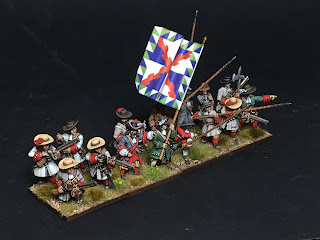
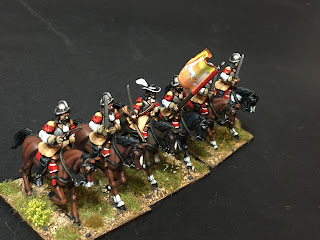
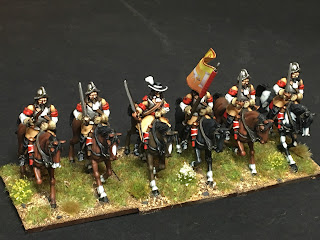
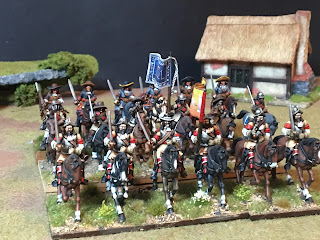
Showing posts with label Miquelets. Show all posts

Sunday, 12 April 2026

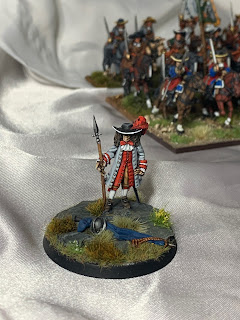
30 Years War Commander base: Catalan/French Josep Margarit

 Hi guys,

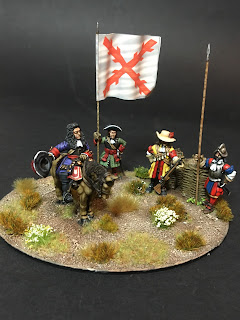
I have just finished a command base for my TYW French army in the Pyrinees/Catalan front. 


As I normally play with  Warlord's Pike & Shotte rules, I need several command bases for the different "battalias" in the games, so I was (and I am!) short of commanders for my armies in the 30 Years War period. 

I wanted a commander who could be a generic general, but also I wanted to paint a miniature based on a real historical character.

So I opted for a Catalan who revolted against the Hispanic crown in 1640, Josep Margarit.

Josep Margarit was the main military commander of the Franco-Catalan forces during the Reapers' War (a War inside the 30 Years War). In January 1641, his actions prevented the Hispanic Crown from supplying its troops during the siege of Barcelona, contributing decisively to the victory at the Battle of Montjuïc.

He later led the defense of Camp de Tarragona, commanding the miquelets, and played a key role in multiple engagements that year: Valls, Cambrils , Constantí (freeing 400 prisoners), and fighting in Montmeló, Vilafranca del Penedès, and La Granada. Some historians attribute his effectiveness to experience in banditry and guerrilla warfare.

In September 1641, he joined a diplomatic mission that secured cooperation with Louis XIII.

Margarit’s military successes made him a prime target for the Hispanic Crown. In 1642, he blocked Castilian troops under Pedro de Aragón from crossing Catalonia to aid forces in Roussillon. He later led the recovery of the Val d’Aran (1643), organized grain supplies for Catalan troops in Lleida (1646), and became the leading figure in the resistance during the siege of Barcelona (1651–52), refusing to abandon the plague-stricken city. 

After its capitulation, he continued leading military raids (Ponts, Solsona, Cardona, Ribelles, Cadaqués, La Seu d’Urgell) in an attempt to regain control of Catalonia. The Treaty of the Pyrenees 1659 ultimately ended his hopes of defeating the Hispanic Crown.


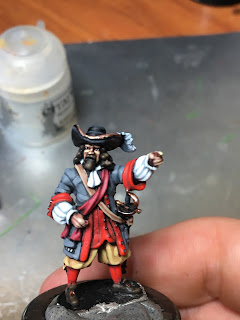
I chose a miniature that had that kind of  strange moustache,  long hair and that black hat similar to those worn by priests. Also the figure had to be in armor, and wear a white sash.

As you can imagine, a I had to make some conversion, I cut a plastic head from one of the commanders of the plastic sprue of Warlord's TYW/ECW captains, and the body of a metal commander from 1898 miniatures.

The other guy in the base is an officer from The Assault Group's TYW range. I painted them using some Foundry Triads , which I love for this period:  Buff Leather , Dark African Flesh, Rawhide...  I personally use a lot these 3 triad for boots, buffcoats, gloves etc.

the  cloth armband in the officer's arm is black , which was the color (along with French white) of the Catalan units in French service or fighting the Spanish.

I hope you like it !


Cheers

Sunday, 8 February 2026

More Civilians, Militias and Miquelets or XVII c. guerrilla mountain skirmishers. Part II

Hello guys,

following the first part: 

https://spanishleadpainting.blogspot.com/2025/12/coming-back-to-siege-of-gerona-1684.html


I have painted six new miniatures for this 17th century civilians and militia reinforcements for my 30 Years War project but also my late XVII c. projects like 1672, and siege of Gerona 1684.

For this, I used three miniatures from Bloody Miniatures, which I absolutely love. These are the first ones I’ve painted from a couple of dozen I own, and I’m very happy with the result. The idea is to use them as armed civilians or musketeers for the Thirty Years War.


I also converted an artilleryman from North Star 1672 to represent a night watchman, adding a plastic lantern or oil lamp.

Another miniature is a second friar (I painted another in December) from Perry Miniatures, originally from their Carlist Wars range and armed with a blunderbuss. However, it works perfectly well as a 17th-century friar.

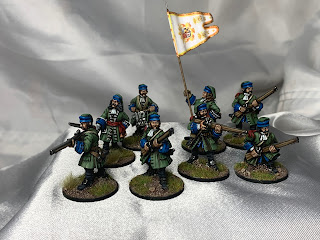
Finally, this is a miguelete/miquelet, wearing the typical Catalan cap, the barretina. On his feet he wears alpargatas, traditional Spanish peasant footwear that has been used for centuries. The miniature was originally a guerrilla fighter from Perry Miniatures’ Napoleonic range, but I removed the anachronistic elements and replaced the sabre-armed hand with a metal, Northstar 1672 17th century musket. I also added a plastic Thirty Years War powder flask from a Warlord Games set.


For painting I used Foundry paints triads (Dark African flesh, Buff, Rawhide, Spearshaft, Forest Green) and Vallejo Model Color.  For  matt varnish I use Ultra matt from Greenstuff world which I recommend.

I also painted a small trench made of resin


I will add more of these, because I want a full second Miquelet unit using these Perry Guerrillas converted, as well as Bloody Miniatures.

Again all the unit so far.


Thursday, 11 December 2025

Coming back to the siege of Gerona 1684: Paisanos or citizens

Miniatures for a XVIIc. besieged city


Hi guys, 

When we recreate the defenders of Girona (or whatever besieged city in this period) on the tabletop, we are not representing a formal army so much as an entire community under arms. The men who held the city’s walls in the 17th century were merchants and craftsmen, hunters and farmers, friars and servants; citizens united by the simple fact that the enemy was at their doorstep. This makes a siege a wonderfully rich setting for miniatures and full of character.

Of course, the following categories are common to most territories of Europe in general, and the Hispanic Monarchy in particular during most of XVII c.

These are the categories I have found.

1) Urban Militias: Girona’s Armed Citizens

The urban militia was composed of the city’s own neighbours: artisans, guild officers, shopkeepers, notaries, apprentices, and even a few minor nobles who commanded small companies. They were civilians, not professional soldiers, serving under Governor Francisco de Taberner with one motivation above all—the defence of their city and their families.

Their equipment reflected this civilian nature. Many carried old matchlock muskets or shotguns; others relied on short pikes, halberds, or arquebuses. Uniforms were rare. Most defenders wore their work clothes or a simple doublet, sometimes with a red cross sewn on the chest to mark their allegiance. Despite their lack of formality, they played a crucial tactical role. They garrisoned the walls, towers, and gates; manned guard posts day and night; supported the artillery by carrying powder, sand, and shot; repaired damaged parapets after bombardments; and rushed to extinguish fires in the aftermath of French shells.


Jurats, civilian authorities in Valencia, mid XVII c. very similar to those present at Gerona

Urban militia in Antwerp, 1670'

                                                            Same Urban militia in Antwerp.


Contemporary testimonies show the determination of these defenders. One chronicler wrote:

“The city, though small in neighbours and with walls not very strong, found itself encouraged by the courage of its inhabitants.”

Another account describes their resilience under bombardment:

“Some neighbours died, and several roofs and warehouses burned; but the spirit of all was so constant that no one showed fear or discouragement.”


2) Rural Militias, Migueletes and Somatén

Beyond the city walls operated a very different kind of force. The rural militias—migueletes and somatenes—were made up of mountain folk from the Ampurdán, Sant Daniel, Amer, Hostalric and the surrounding valleys. These were former soldiers, hunters and labourers, accustomed to the rugged landscape and skilled with firearms. They were officially recognised as auxiliaries by the viceroy but operated with considerable independence under local chiefs and minor lords.


Girona could mobilise several hundred men in the countryside, while within the city itself up to 600 or 800 men could be deemed fit for arms, with around 300 more available in emergencies. The municipality carried out censuses prior to expected attacks—in 1637, 1667, 1675, and 1684—to determine who could serve. Even the cathedral chapter, the bishop, and the religious orders contributed armed companies during the worst sieges.


The migueletes and somatenes excelled in irregular warfare. They ambushed French convoys, destroyed baggage trains, cut communications, and fired from natural cover before vanishing into the hills. A contemporary account states:

“The migueletes and somatenes of the mountains caused constant losses to the French detachments, taking baggage and prisoners every day.”


Their clothing was equally distinctive and ideal for miniature painters: brown or grey woollen coats, linen shirts, red sashes, barretinas, and sturdy shoes or espadrilles. They often carried long flintlock escopetas, knives, and small leather pouches. Another source gives a vivid image of their appearance:

“The migueletes from Amer and Hostalric arrived wearing brown or grey clothing, low hats, red sashes, and a leather cartridge-box over the shoulder; armed with musket or blunderbuss. Some wore short checkered mountain capes.” I painted several Migueletes a few years ago, featured in this post: 

https://spanishleadpainting.blogspot.com/search/label/Miquelets?updated-max=2021-01-09T12:18:00%2B01:00&max-results=20&start=2&by-date=false


Some of them were led by D. Josep de Trinchería, and later during the 9 Years War, by his son, D.Blas de Trinchería.

A detailed description of D. Josep de Trinchería has survived until today:

"He wears his hair long, following the custom of the time, and a waxed mustache curled upward in keeping with the family portrait. A mid-thigh coat (the habit), with open sleeves revealing the shirt beneath, trimmed along the edges and seams. It is buttoned at the front. Around his waist he carries a belt serving the dual purpose of ornament and support for his weapons. Draped over his left shoulder is a cape which, in the fashion of the era, wraps around his right hand, with which he holds the French-style hat (chapeau). He wears tight-fitting breeches of the same cloth, fastened with ribbons, and tall boots with gaiters. The boots include the gaiter that holds the spur used when riding on horseback.

He is armed with a cup-hilt sword hanging from a leather strap, a flintlock of three palmos and another shorter one, along with its corresponding pouch for stones and bullets, as well as a flask with a measure for carrying gunpowder."


                                                                D.Josep de Trinchería 


"Angelets de la terra" /Migueletes guerrilla fighters


3) Clergy and Non-Combatants


The city’s defence was not limited to armed men. Secular priests and members of the mendicant orders—Dominicans, Franciscans, Capuchins—were present on the walls, tending the wounded and encouraging the defenders. Women, servants, children and the elderly played essential roles as well, carrying water, soil and stones for the artillery and helping repair damage after bombardments. Public prayers and religious processions were organised to keep morale high.

A contemporary testimony describes their presence vividly:

“The friars of the mendicant orders assisted on the walls, encouraging the people with the word of God and aiding the wounded.”


4) Civic Officers and Command Figures


At the top of Girona’s civic defence stood the "Jurat en Cap" and the colonel of the militia. They added a rare note of splendour amid the city’s improvised forces. One account describes them as wearing crimson coats trimmed with gold during public ceremonies, and donning light cuirasses or breastplates over their doublets in battle. Their swords, it says, had gilt hilts with shell-shaped guards:

“The chief jurat and the colonel of the militia of Girona wore crimson coats with golden braid in public acts, and in combat covered themselves with a light cuirass or breastplate over the doublet. Their sword had a gilded hilt with a shell-shaped guard.”


Painting Girona’s defenders offers an extraordinary palette of textures and personalities—ragged walls, improvised weapons, bright red sashes, guild banners, mountain cloaks, friars with bandages, servants rushing powder barrels. 

In future posts I will prepare siege workers and engineers for 30 Years War and also late XVII c.


                               "Perry Miniatures" Priest and "Anno Domini 1666" Night Watch.


The miniatures I am using for these chaps are: 

-Priests : Perry miniatures 28mm Napoleonic/Carlists wars Spanish priest, I bought several of these, but I will only use those whose attire fit in XVII c. in classic friar appearance. 

-Miquelets or Miguelets, I have already several of these, but I want another company of these skirmishers, I really like Front Rank Monmouth rebels with some conversions, I will also use the new Perry Napoleonic guerrilla fighter sprue in plastic, for pieces and headgear like the Catalan cap, the barretina, mixed with Front Rank or  Northstar 1672 bodies.

-For civilians and urban militias I am using several miniatures from Anno Domini 1666 miniatures, a Polish company of great quality, also Bloody Miniatures 28mm ECW and TYW figures are stunning, and some of them are suitable for later periods, specially civilians.


I hope you like it!


Cheers

Monday, 31 January 2022

Wargaming and painting Late Spanish Tercios / Review of WARS AND SOLDIERS IN THE EARLY REIGN OF LOUIS XIV VOLUME 4 The Armies of Spain 1659-1688


Hello guys, this is the same blog entry I have done for Helion & Company blog

 This post is some kind of review of Bruno Mugnai's excellent book : WARS AND SOLDIERS IN THE EARLY REIGN OF LOUIS XIV VOLUME 4 The Armies of Spain 1659-1688

                                               Wars and Soldiers in the Early Reign of Louis XIV Volume 4 : The Armies of Spain 1659-1688


you can buy it here: 

https://www.helion.co.uk/military-history-books/wars-and-soldiers-in-the-early-reign-of-louis-xiv-volume-4-the-armies-of-spain-1659-1688.php?sid=748f5d4ace837638de79a074ca583d56 

If you are interested in military of XVII c.  This books is definitely for you, Helion has produced for the first time in the world, a book dealing with the last Tercios of Habsburg Spain, and it does not disappoint!

Bruno has done (as he usually does) a fantastic job with this volume, it is a long book, with more than 360 pages, full of maps, pictures, paintings, color plates, flags, orders of battle...

It is structured as follows,

1. Spain, or ‘the Resiliance’ 

With the structure of the Spanish Monarchy,  territories, economy, personalities, politics,  military situation...

2. Soldados del Rey 

The different armies, nations of the Spanish empire, types of troops.

3. Spanish Warfare 

Strategies, battles, campaigns, etc.

4. Uniforms, Equipment and Flags 

Well, The most complete description of this subject in English :)

Appendix I: Spain Orders of Battle

Appendix II: List of Tercios, Trozos and Regiments, 1659–1688 


The Spanish Army of Charles II Habsburg “The Bewitched” (1665-1700) was not the army that had dominated the European battlefields in the first decades of the century… Decades of uninterrupted war, famines, bankruptcy and diseases had decreased Spain’s ability to field and train soldiers in the same numbers of Philip IV, but despite the evident decadency,  The Spanish tercios, with the inestimable aid of his allies, mostly held their ground in the face of a much stronger French army during 30 years of almost permanent aggression, at the cost of some territories and cities in Flanders and the loss of Franche Comté, but The Spanish Empire survived almost intact until the next dynasty and War of Spanish Succession.

This army (or theatre of operations) have been neglected in our wargaming world until very recent times,  even in Spain, but thanks to the effort of several publishers and historians including the the new book on this subject by Helion Publishing and Bruno Mugnai, the interest in late XVII century and particularly Spain in this era, is increasing.


                                                                Spanish cavalry 1660-70


(Tercio of Toledo, "Old Blues")


(Spanish Marquis of Castel Rodrigo, 1668, Flanders. conversion)


(Spanish Standard Bearer 1660', Foundry conversion)


                    (Front Rank officer and flag bearer, also a couple of individually sculpted soldiers)
(Front Rank and North Star conversions of Officer and rodelero)


                (Front Rank Spanish Dragoons of Tercio of Vanderpit/Valanzart in 1696, Flanders)


                                                (North Star Spanish Officer in Flanders, 1670')


(mixture of figures; Firelock games Spanish officer with Front Rank converted miniatures) 


Spain had in these times three (four If we include the Army of Extremadura until 1668) standing armies, the Army of Flanders, the Army of Milan and the Army of Catalonia, apart from smaller armies and garrisons in African “presidios” ,  Naples, Sicily, Sardinia and the Americas.

The most professional and trained army was the veteran Army of Flanders,  active from 1567, it numbered 62.500 men in 1668, at the end of the War of Devolution, 48.000 men in 1675 during Franco Dutch War, and even during the League of Augsburg War, the Spanish army of Flanders fielded 25.000 men in 1690 and 15.000 in 1695.

We can conclude that the French would have overran the Dutch Republic in 1673 without the aid of the Army of Flanders. 

In Milan, the Spanish maintained between 10.000 and 20.000 (at its peak) during the last quarter of the century, and was the backbone of the allied army during the League of Augsburg War,  aiding the Duke of Savoy, along the expeditionary forces of the Holy Roman Empire.  Moreover, the army of Milan provided most of the artillery to the allies during that conflict.


In Catalonia the Spanish had the weakest of the three field armies, composed by only 5 veteran tercios … and some cavalry trozos (regiment equivalent), the rest of the army was of lesser quality recruits, and their performance in battle was worse than in Flanders and Italy. That was because of the secondary role of that front during all the wars, considered secondary by both, the French and the Spaniards.


I think this army has been mistreated by historiography until very recent times, in part thanks the “new“ (and current) Bourbon dynasty in Spain, who wanted to present themselves as the modernizers of an outdated and inefficient Habsburg military structure, but this claim was not true, despite the propaganda, which lasted until the last century. 

Although most field battles were won by the French in all  late XVII century wars, the allies and the Spanish in particular had successes too  in all these wars, we can just mention a few like:

-Battle of Dendermonde 1667

-Siege of Bellegarde 1673

-Battle of Maureillas/Morellás 1673

-Battle of Saint Dennis (draw) 1678

-Reconquer of Sicily 1678

-Siege of Gerona 1684

-sieges of Ceuta, Melilla, Oran… against the Moors and Algerians

-French invasion of Catalonia 1689

-Siege of Casale 1695


                            (North Star 1672 musketeer, Foundry engineer with Warhammer head)

Apart from that, the Spanish role in the Allied war effort was inmense, and often neglected. As Flanders was the main front of all the conflicts, both French and Spanish invested there their best units, but also had to withdraw thousands of men and resources in order to assist fronts in Catalonia and Italy thus relieving pressure on the Netherlands. Moreover, several German regiments and auxiliaries were paid by the Spanish crown. 

In terms of logistics and artillery, The Spanish army of Milan supplied the Allies in Savoy with the vast majority of the artillery train in the different campaigns during the League of Augsburg War, especially during the siege of Casale Monferrato in 1695. 

In Flanders, the Spanish supplied the English Expeditionary army in 1678 with hundreds of charts and artillery, as the English had no logistical system available to that campaign.

Spanish cavalry was highly regarded by both , friends and enemies, in general terms it was superior to French cavalry, and during Franco Dutch war and League of Augsburg War, always fought in the right wing of the Allied army, as this was the place of honour in the battle line. William III and Waldeck made continuous requests for help in terms of cavalry units to the Army of Flanders, in order to relieve his relative weakness in that field, in exchange of Dutch infantry to man the Flemish frontier’s fortresses.

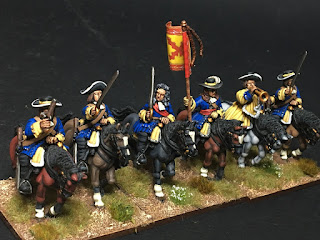


(Tercio of Cavalry of Vaudemont, Flanders, League of Augsburg War  and Trozo of Extremadura, same conflict, Catalonia, all Front Rank miniatures)


As you can see, this army is very interesting to paint and play, because you can use it in several conflicts and several locations, Flanders, Alsace and Rhine, Savoy, Sicily, North Africa, and Catalonia.  You also can field Spanish tercios in your Allied armies of Franco Dutch War and League of Augsburg War along Dutch, English, German, Austrian or Italian regiments.

In my opinion is one of the most colourful armies of the period, with uniforms of almost every colour possible (even purple!) also the flags are interesting too, they usually carry the classic Burgundy cross in different backgrounds, from plain white, to intricated geometric forms.


Talking about the miniatures, I have been using a lot of different manufacturers since I started collecting  some years ago (more or less in 2013) When I saw for the first time an advertisement of Barry Hilton's Warfare Miniatures and ex Copplestone North Star 1672.

I found out that there were no proper Spanish miniatures in the market a few years ago, except for the short lived "Phoenix Miniatures" XVII Spanish range, which was part of North Star, sadly that range was not complete and was withdrawn...  but now North Star 1672 has launched a new range of Spanish troops with their typical long coat with high cuffs and front lapels.

Talking about uniform colours, in Bruno Mugnai's book, you have the DEFINITIVE guide about painting them, because there is an appendix with virtually all of the known Tercios and their uniform if there are records of them.

In general terms,  Spanish troops in Spain were the most colorful, with a motley collection of colors available. In Flanders it was common to see Spanish troops dressed in grey with red facings, also blue. In Milan, Tercios had a tendency to be dressed in red and yellow.  Neapolitans and Aragonese usually wore blue... So there was no fixed parameter, but there were some local trends
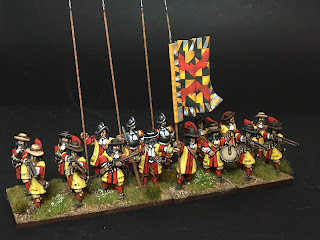
                                    

(Tercio “Old Yellows”, one of the 5 veteran infantry tercios in Catalonia, Phoenix Miniatures, some conversions and some custom sculpted miniatures )

Those miniatures are suitable roughly from the War of the Devolution 1667-68, until the League of Augsburg War. But you can also use Front Rank miniatures and Warfare Miniatures for the League of Augsburg  War.    Also Dixon’s  Miniatures and Wargames Foundry are suitable, although smaller in size.

I can't tell what is the BEST range... It depends on the exact conflict you are playing and painting...

If you want to play Portuguese Restoration War and War of Devolution (mid to late 1660') I would go for a mixture of 30 Years War/English Civil War minis and 1670' miniatures like for example, the brand new Bloody Miniatures, Bicorne Miniatures with some Reiver Castings new range of 1670' miniatures, and of course North Star 1672 !!

If you go for Franco Dutch War, my choice would be North Star 1672 and Reiver Castings new range on that conflict. Also Front Rank miniatures to add some variety and officers.


(Front Rank, Warlord games (converted), Northstar/Phoenix Miniatures... Franco Dutch War, Spanish troops in Flanders)

If your choice is League of Augsburg, then go for Warfare Miniatures and Front Rank, they are my favourite for 1690' uniforms. Also some miniatures from War of Spanish Succession would be useful here, for instance Ebor Miniatures, which produces very nice miniatures that fits perfectly in 1690's like their Imperial Cuirassiers, Saxon cavalry, French Dragoons, or Spanish Grenadiers!


                                                   (Warfare Miniatures' Officers)

Dixon's Miniatures and Foundry Miniatures are smaller than the previous ranges, and I like bigger figures BUT they are super nice and full of character, some of their miniature show their age ,but I am always happy to mix them in my units or making small dioramas and scenes with them.

I am sorry If I have forgotten some miniature ranges here, but with some conversion, you can use


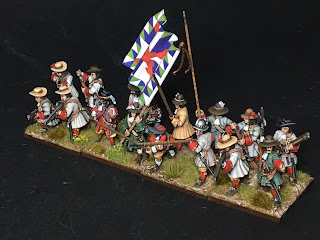
(Spanish militia unit in Catalonia, mixture of Warfare Miniatures, Warlord Games, Dixon’s…)
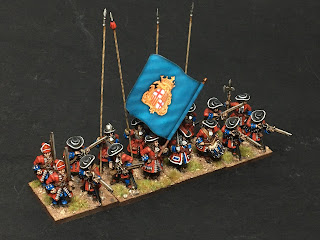


                                                    (Tercio of Barcelona,  1696)


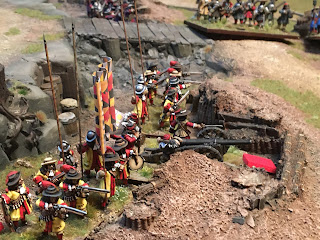
       (Migueletes, Catalan irregulars, caused the majority of French causalities during the Catalonian campaign of 1695-96)


With all those great ranges, and flags from the internet, books and manufacturers like Adolfo Ramos, Flags of War and such, you can perfectly field a small contingent of Spanish allies to your Dutch or English army.

I hope you have found this little approach to the late Spanish tercios somehow interesting.

Finally, I would like to thank Helion Publishing, Charles Singleton, Bruno Mugnai and Barry Hilton amongst many others who, with their work and research, help to increase people's interest in this exciting period of history and this hobby.


Jose Maria Cagiga Mata


Bibligraphy:

- Bruno Mugnai : WARS AND SOLDIERS IN THE EARLY REIGN OF LOUIS XIV VOLUME 4 The Armies of Spain 1659-1688 (HELION)

-Maffi, Davide. Los últimos tercios. El Ejército de Carlos II. 2020

- (various) Desperta Ferro magazine: Los Tercios (VI). 1660-1704. 2019

-Espino López, Antonio. Las Guerras de Cataluña 1652-1700. 2014

- Giancarlo Boeri, Jose Luis Mirecki, Jose Palau, Robert Hall .Spanish Armies in the War of the League of Augsburg, 1688-1697. 2011

- Lynn, John A. The Wars of Louis XIV, 1667-1714. 1999